
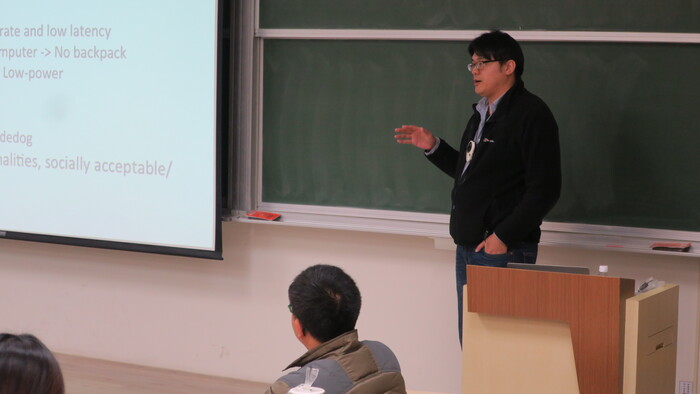
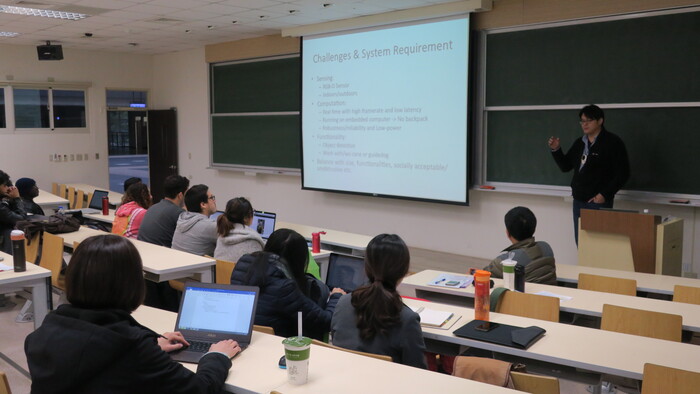
Seminar of Institute of Information Systems and Applications
|
Speaker : |
Prof. Hsueh-Cheng Nick Wang (National Chiao Tung University) |
|
Topic: |
Toward Autonomous Navigation for Individuals |
|
Date : |
15:30-17:00 Wednesday 08-Mar-2017 |
|
Place : |
台達館R107(Delta Building R107) |
|
Host: |
Prof. Min Sun |
Abstract
Autonomous driving has become one of the most impactful topics in recent years. In the first part of the talk, I will introduce Duckietown: an open, inexpensive and flexible platform for autonomy education and research. The platform comprises small autonomous vehicles (“Duckiebots”) built from off-the-shelf components, and cities (“Duckietowns”) complete with roads, signage, traffic lights, obstacles, and citizens (duckies) in need of transportation. The Duckietown platform offers a wide range of functionalities at a low cost. Duckiebots sense the world with only one monocular camera and perform all processing onboard with a Raspberry Pi 2, yet are able to: follow lanes while avoiding obstacles, pedestrians (duckies) and other Duckiebots, localize within a global map, navigate a city, and coordinate with other Duckiebots to avoid collisions. Duckietown is a useful tool since educators and researchers can save money and time by not having to develop all of the necessary supporting infrastructure and capabilities.
The second part of the talk will focus on how to transform the the technology of autonomous driving into a wearable system to provide situational awareness for blind and visually impaired people. The system includes a camera, an embedded computer and a haptic device to provide feedback when an obstacle is detected. The system uses techniques from computer vision and motion planning to (1) identify walkable space; (2) plan step-by-step a safe motion trajectory in the space, and (3) recognize and locate certain types of objects, for example the location of an empty chair. These descriptions are communicated to the person wearing the device through vibrations. We present results from user studies with low- and high-level tasks, including walking through a maze without collisions, locating a chair, and walking through a crowded environment while avoiding people..
Bio
Dr. Wang is an assistant professor in the Department of Electrical and Computer Engineering, National Chiao Tung University, Taiwan. He was a postdoctoral associate in the Marine Robotics Group (MRG) in the Computer Science and Artificial Intelligence Laboratory (CSAIL), MIT from 2013 to 2016. Dr. Wang received Ph.D. from Department of Computer Science, UMass Boston, and his B.S. and M.S. in National Taiwan University. Dr. Wang focuses on developing robotic systems to solve real-world problems in direct support of individuals.
All faculties and students are welcome to join.