

PhD Opening: Adaptive Bitrate (ABR) Algorithms for Six Degree-of-freedom Virtual Reality Streaming
About the Project:
This project is part of a 4 year Dual PhD degree programme between the National Tsing Hua University (NTHU) in Taiwan and the University of Liverpool in England. As Part of the NTHU-UoL Dual PhD Award students are in the unique position of being able to gain 2 PhD awards at the end of their degree from two internationally recognised world leading Universities. As well as benefiting from a rich cultural experience, Students can draw on large scale national facilities of both countries and create a worldwide network of contacts across two continents.
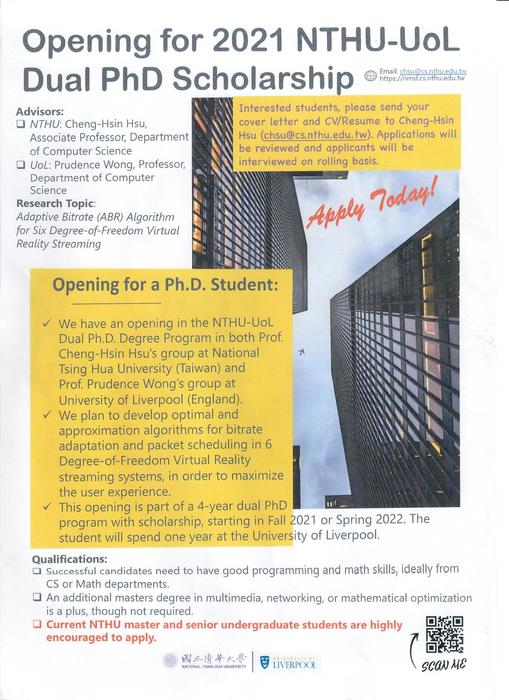
This project plans to develop optimal and approximation algorithms for bitrate adaptation and packet scheduling in 6 Degree-of-Freedom Virtual Reality streaming systems, in order to maximize the user experience.
Current NTHU Masters and undergraduate students are highly encouraged to apply. For enquires, please contact Cheng-Hsin Hsu (chsu@cs.nthu.edu.tw).
More info can be found below.
(a) Supervisors’ affiliation & contact details
NTHU: Cheng-Hsin Hsu (chsu@cs.nthu.edu.tw), Associate Professor, Department of Computer Science
UoL: Prudence Wong (P.Wong@liverpool.ac.uk), Professor, Department of Computer Science
(b) Project title, aim & objectives
Adaptive Bitrate (ABR) Algorithm for Six Degree-of-Freedom Virtual Reality Streaming.
We plan to develop optimal and approximation algorithms for bitrate adaptation and packet scheduling in 6 Degree-of-Freedom Virtual Reality streaming systems, in order to maximize the user experience.
(c) Outline of background and proposed research methodology Virtual Reality (VR) technologies have gained immense popularity, as indicated by the number of Head-Mounted Displays (HMDs) and VR applications hitting the market. Conventional VR only supports 3 Degrees-of-Freedom (3-DoF), which enables 360-degree viewing orientations using 360-degree videos. However, users can just rotate their heads to see different orientations but can not move or walk within VR environments. 6 Degree-of-Freedom (6-DoF) was proposed to allow users to change their positions freely. To enable 6-DoF VR, various 3D data representations, e.g., point cloud, mesh, multi-view videos, and light field, are needed to describe 3D scenes. These representations have tremendous data size and are hard to be transmitted in real-time by the current network. To solve this problem, we plan to develop novel Adaptive Bitrate (ABR) algorithms to dynamically adjust the bitrate of 6-DoF streaming according to available bandwidth. To the best of our knowledge, ABR algorithms for 6-DoF VR streaming have not been investigated until very recently. For example, Van der Hooft et al. [1] proposed a streaming system for point clouds consisting of multiple objects. They designed several heuristic ABR algorithms to adjust bitrate according to the user's states and network conditions. Qian et al. [2] proposed a volumetric streaming system for commodity mobile devices, which leveraged edge computing and rate adaptation to adapt bandwidth and reduce motion-to-photon delay dynamically. These two, and other similar studies only adopted heuristic ABR algorithms with little, if any, performance guarantees. This project aims to develop a general ABR algorithm framework suitable for heterogeneous 3D data representations used in 6-DoF VR streaming.
[1] Jeroen van der Hooft, Tim Wauters, Filip De Turck, Christian Timmerer, and Hermann Hellwagner, "Towards 6DoF HTTP adaptive streaming through point cloud compression." in Proc. of the ACM International Conference on Multimedia (MM’19). October 2019.
[2] Feng Qian, Bo Han, Jarrell Pair, and Vijay Gopalakrishnan, "Toward practical volumetric video streaming on commodity smartphones." In Proc. of the ACM International Workshop on Mobile Computing Systems and Applications (HotMobile’19). February 2019.
(d) Proposed programme of study at NTHU (at least 4 semesters) and UoL (at least 12 months) The Ph.D. student will spend 18 months at NTHU getting familiar with the 6-DoF Virtual Reality streaming systems while taking the fundamental courses (see below). After that, the student will spend 12 months at UoL working with Prof. Wong on the algorithm design. Following that, the student will spend at least 18 months at NTHU implementing the proposed algorithm in real streaming systems and wraping up the dissertation. The students will be affiliated with the Department of Computer Science at NTHU and UoL.
(e) Complementarity of expertise and, or facilities at NTHU & UoL
NTHU: Cheng-Hsin has extensive experience in networked and multimedia systems. He has been working on 3-DoF video streaming to Head-Mounted Displays (HMDs) for 4 years. Recently, he has started tackling more challenging 6-DoF video streaming, which dictates even more efficient optimization and scheduling algorithms for a good user experience. His lab at NTHU will provide all the equipment required by the students, including HMDs and GPUs. His expertise and advice on the system side will increase the practicality of the research outcome.
 Adaptive Bitrate (ABR) Algorithms for Six Degree-of-freedom Virtual Reality Streaming.pdf