

Empirical Investigation of Sharing and Community Building in Scientific Software & Supporting Civic Activities with Machine and Human Computation
Topics (1)
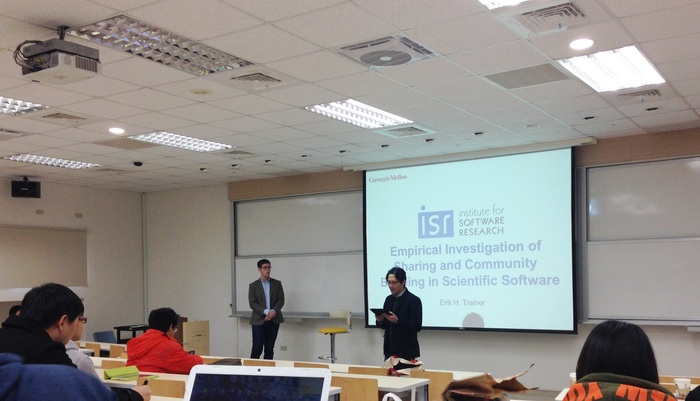
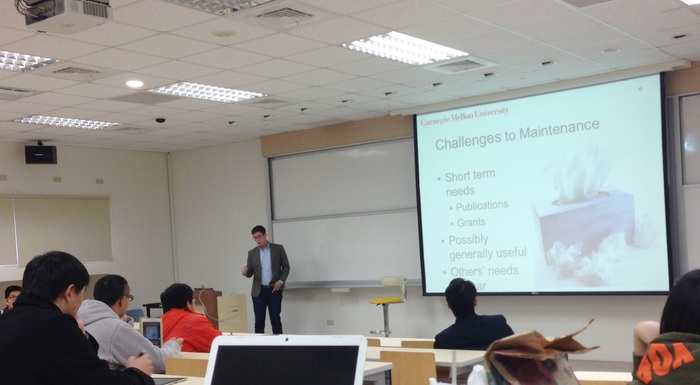
Speaker: Dr. Erik Trainer(Carnegie Mellon University)
Topic: Empirical Investigation of Sharing and Community Building in Scientific Software
ABSTRACT:
Science depends crucially on software. Visualization, simulation, and analysis are all at the heart of scientific practice — and all rely on software. Unless it’s maintained, the software soon becomes useless. It's generally agreed that open-source is a good candidate development model, but that building shareable software takes much more work than building software for personal use. Scientists, however, generally have little incentive to do that work. Other scientists, who would be willing to invest time to adapt, extend, and maintain tools to meet their own needs, are often deterred by the lack of social infrastructure and unfamiliarity with the code base. In this talk I will give an overview of two research projects we have been conducting to understand 1) the work required to turn a personal tool into a community resource, and 2) the role of community code engagements (CCEs), short-term, intense software development events in building community around scientific software. I will present results showing that, under many conditions, scientists are willing to undertake "extra work" to turn their tools into a community resource. I will also present results showing that CCEs hold promise for identifying community needs, strengthening and creating new social ties, and encouraging and enabling needed “extra work.”
BIOGRAPHY:
Erik Trainer is a postdoctoral researcher in the Institute for Software Research at Carnegie Mellon University. He is interested in the relationship between collaborative software development processes and social dynamics, and in developing tools and techniques to help software teams. He has studied trust in globally distributed software teams, visual interfaces to support awareness of software development activities, and community engagement around scientific software. He has published in a number of software engineering and computer-supported cooperative work venues. Erik received his B.S. and Ph.D from U.C. Irvine under David Redmiles.
Topics (2)
Speaker: Dr. Patrick Shih ( Penn State University)
Topic: Supporting Civic Activities with Machine and Human Computation
BIOGRAPHY:
Dr. Patrick C. Shih received his B.S. in Computer Science and Engineering from UCLA (2003), M.S. in Information Networking from Carnegie Mellon (2005), and Ph.D. in Information and Computer Science from UC Irvine (2011). In 2012, he joined the College of Information Sciences and Technology at Penn State as a Research Associate and Lecturer.
Date: Wednesday, 17 Dec. 2014, 1:20pm ~ 3:00pm
Place: R105 Delta Building (台達館)
Speaker: Dr. Erik Trainer(Carnegie Mellon University)
Topic: Empirical Investigation of Sharing and Community Building in Scientific Software
ABSTRACT:
Science depends crucially on software. Visualization, simulation, and analysis are all at the heart of scientific practice — and all rely on software. Unless it’s maintained, the software soon becomes useless. It's generally agreed that open-source is a good candidate development model, but that building shareable software takes much more work than building software for personal use. Scientists, however, generally have little incentive to do that work. Other scientists, who would be willing to invest time to adapt, extend, and maintain tools to meet their own needs, are often deterred by the lack of social infrastructure and unfamiliarity with the code base. In this talk I will give an overview of two research projects we have been conducting to understand 1) the work required to turn a personal tool into a community resource, and 2) the role of community code engagements (CCEs), short-term, intense software development events in building community around scientific software. I will present results showing that, under many conditions, scientists are willing to undertake "extra work" to turn their tools into a community resource. I will also present results showing that CCEs hold promise for identifying community needs, strengthening and creating new social ties, and encouraging and enabling needed “extra work.”
BIOGRAPHY:
Erik Trainer is a postdoctoral researcher in the Institute for Software Research at Carnegie Mellon University. He is interested in the relationship between collaborative software development processes and social dynamics, and in developing tools and techniques to help software teams. He has studied trust in globally distributed software teams, visual interfaces to support awareness of software development activities, and community engagement around scientific software. He has published in a number of software engineering and computer-supported cooperative work venues. Erik received his B.S. and Ph.D from U.C. Irvine under David Redmiles.
Topics (2)
Speaker: Dr. Patrick Shih ( Penn State University)
Topic: Supporting Civic Activities with Machine and Human Computation
BIOGRAPHY:
Dr. Patrick C. Shih received his B.S. in Computer Science and Engineering from UCLA (2003), M.S. in Information Networking from Carnegie Mellon (2005), and Ph.D. in Information and Computer Science from UC Irvine (2011). In 2012, he joined the College of Information Sciences and Technology at Penn State as a Research Associate and Lecturer.
Date: Wednesday, 17 Dec. 2014, 1:20pm ~ 3:00pm
Place: R105 Delta Building (台達館)